A Conversation with Angela Gheorghiu
Wednesday, May 15, 2013 by Noel Morris
Wednesday at 9:00 PM
In an exclusive conversation recorded for the WFMT Radio Network, the acclaimed soprano Angela Gheorghiu discusses with Jon Tolansky her brand new CD she has entitled Angela Gheorghiu – Homage to Maria Callas: Favourite Opera Arias, which EMI Classics releases in November.
In her conversation, Angela Gheorghiu speaks about the very wide range of styles and characters she sings on the new disc, which contains opera arias by Verdi, Puccini, Gounod, Bellini, Leoncavallo, Saint-Saëns, Catalani, Bizet, Giordano, Cherubini, Massenet and Cilèa.
Hear Angela Gheorghiu discussing Saint-Saens’ treatment of the biblical character, Delilah:
Audio clip: Adobe Flash Player (version 9 or above) is required to play this audio clip. Download the latest version here. You also need to have JavaScript enabled in your browser.
Download MP3 (right-click and choose save as to download)
Don’t Just Listen to Tannhäuser
Tuesday, May 14, 2013 by Noel Morris
The Tuesday Night Opera presents Tannhäuser at 8:00 PM.
The iPad is popping up in unexpected places. One person was spotted reading Bach’s B Minor Mass in the box seats at Symphony Center—this while Riccardo Muti, four soloists and the CSO Chorus were singing their hearts out. Artists are starting to use the iPad on music stands in place of sheet music: no more page turns (the music scrolls according to the desired tempo), and it’s a compact method of transporting a music library.
In the past, only the most diehard music fan would think of procuring the score to a favorite piece. Scores are not sold in many places; they’re unwieldy, and even intimidating if one is unaccustomed to looking at lots of notes. It’s easy to get lost, but the rewards are enormous. There is something about seeing the composer’s craft unfold before your very eyes that’s inspiring, even thrilling. After all, a performance is but an interpretation of what’s on that page. A listener who’s looking at the notes, starts to hear musical lines that may not be emphasized by a particular conductor (not that they necessarily should be).
Tonight at 8:00 PM, you have the opportunity to try your own hand at this. Wagner’s Tannhäuser is the Tuesday night opera.
Here is the score; now get ready.
Postcards from Russia – An American Orthodox Celebration – Part 8
Tuesday, May 14, 2013 by Cydne Gillard
Пасха – Orthodox Easter
As I, Zack Ellis*, prepared to pack my bags to travel with the Mariinsky Orchestra, I learned a lesson about the serendipity of life. In a small hamlet 4,500 miles from Moscow, a monastery called St. Tikhon’s keeps Russian Orthodox traditions alive in Pennsylvania. On May 5, I had the pleasure of attending their midnight Easter service, and received an early dose of Russian culture.
Unlike western churches, Russian Orthodox still follows the Julian Calendar. This often results in their Easter being celebrated several weeks after the Catholic Easter. This year, it happened to fall on May 5. The service began shortly before midnight.
Everybody in attendance held a lit candle as we stood in the nave of the church. The lights were dimmed, and we gathered around a funeral shrine dedicated to Christ. The deacon spoke and the choir sang a somber chant before we formed a funeral procession outside. An iron bell tolled while we circled the church three times. Upon returning to the door, the deacon climbed the steps and issued a proclamation in Church Slavonic: “Христос воскресе! (Christ is risen!).” The congregation responds: “Воистину воскресе! (Truly, He is risen!).” This was repeated in Greek and English due to the makeup of the congregation. The choir sang and this joyous exchange took place several more times before we re-entered the church.
The nave had become bright and cheerful. In place of the funeral shrine were bright celebratory icons of the resurrection. Bathed in light, we could see the icons and imagery upon the iconostasis – the decorative wall between the nave and the sanctuary. The priest began the hymn, “Christ has Risen from the dead, by death trampling upon Death, and has bestowed life upon those in the tombs,” and the congregation joyously sang this motif throughout the service. This progressed to the church’s traditional liturgy.
Many people fast for forty days prior to the holiday, giving up meat, eggs, and cheese in a test of self-discipline. Upon conclusion of the service, everybody met in a hall and we broke the fast. Meat and cheese abounded. The celebration continued through the night, and the congregation retired before sunrise.
Easter festivities often continue long after the holiday. Such is the case for the Mariinsky Easter Festival. Music and celebration transcend national boundaries. Although we ventured to the far side of the world, we still feel connected to home.
*Zack Ellis is an undergraduate at Northwestern University
Postcards from Russia – The Mariinsky Train Experience – Part 7
Monday, May 13, 2013 by Cydne Gillard
Привет! I’m Bridget Rodino, a music student at Northwestern University, traveling on the Easter Festival Train with WFMT’s Cydne Gillard, and a group of people from Chicago. Being on the Mariinsky Orchestra’s Easter Festival Train is a special experience. We all have compartments next to one another, just two cars behind Maestro Gergiev himself. Two cars in the other direction is the dining car. Every table is decorated with fresh flowers; intricate woodworking surrounds us.

Beautiful flowers every where we look!
We have eaten a few meals on the train so far and each one has been delicious. Some of our favorite dishes have been the kasha, a white porridge breakfast staple, and borscht, a traditional Russian beet soup. One adventure was that the spicy mustard served with our breakfast-just a little bit and your eyes water.
Sleeping on a train is surprisingly comfortable. Keryn and I are both studying music performance at Northwestern and love experiencing the life of a traveling musician. Most of our logisitics are arranged by Katya Gorbacheva from the Mariinsky Foundation of America. Her bright, energetic personality keeps us going throughout the day between the numerous destinations. Nina, our car’s personal stewardess, keeps the environment homey, waking us up in the morning asking, “Kafe or chey?” (Coffee or tea?) We love waking up to her warm smile.
Postcards from Russia – Contrasts of the Countryside – Part 6
Monday, May 13, 2013 by Cydne Gillard
Welcoming us to the Easter Festival Tour train, our stewardess, Nina, sweetly tells us everything in Russian. We listen and obey. Often we are visiting two or three cities a day with a concert in every city: St. Petersburg, Moscow, Smolensk, Bryansk, Belgorod, Kursk, Oryol, Tula, Kaluga, Nizhny Novgorod, Kostroma, Yaroslavl, Vologda, Cherepovets.
As we travel through the countryside, we see Russia’s beautiful birch forests and great expanses of plains. Occasionally we roll past small villages. The contrasts between these communities and the great cities of the Golden Circle—the cluster of metropolises within 300km of Moscow—are remarkable. Moscow is one of the most modern cities in the world. Glass and steel skyscrapers rise past the old cement high-rises in a display of urban evolution. Meanwhile, clusters of wooden cottages in the forest huddle together as if they’re trying to keep warm. High-tech subways and trams carry Muscovites to shopping malls and symphonies, while the rural Russian trusts his rusty old motorcycle to meander between strolling villagers along a single dirt road.
Chime in: What Piece from the Past 25 Years Do You Think Has Staying Power?
With the launch of our sister station’s 10 Buildings that Changed America, WFMT poses the question, what pieces of music have that kind of significance? For Lasting Impressions, WFMT asked a dozen critics, conductors, and composers, “Which single piece written in the last 25 years do you think will still be heard in 100 years?” How would you answer that question?
Mei-Ann Chen on Getting to Know Scheherezade, Florence Price and the CSO
Friday, May 10, 2013 by Noel Morris
One only has to spend a few minutes with Chicago Sinfonietta Music Director Mei-Ann Chen to figure out how she’s energizing Chicago’s music community. The Taiwanese conductor sparkles with enthusiasm, comparing the CSO to getting behind the wheel of a Porsche for the first time.
Here Ms. Chen thumbs through the score of Florence Price’s Mississippi River:
Audio clip: Adobe Flash Player (version 9 or above) is required to play this audio clip. Download the latest version here. You also need to have JavaScript enabled in your browser.
Download MP3 (right-click and choose save as to download)
This weekend marks Ms. Chen’s Chicago Symphony Orchestra subscription debut in a concert that represents the confluence of several efforts: the CSO’s Rivers Festival, which presents music about different waterways while raising awareness about the ecology of our own rivers—the rivers component of this weekend’s concerts features a work by bygone Chicago composer, Florence Price, whose symphony was premiered by the CSO back in the 1930s, making her the first female, African-American composer to have a work played by a major orchestra. This weekend also offers a Beyond the Score, which will use actors, visual effects and musical excerpts played live by the CSO to highlight Rimsky-Korsakov’s Scheherazade; these CSO concerts also offer a friendly handshake between two local orchestras: the CSO and Chicago Sinfonietta.
The Beyond the Score concerts are Friday and Sunday. The subscription concerts are Saturday and Tuesday.
10 Pieces That Changed the World
Thursday, May 9, 2013 by Noel Morris
Hear the music on Friday, May 10, starting at 9:00 AM
As our sister station, WTTW launches 10 Buildings that Changed America, we at WFMT thought perhaps it was time for some reflection on the art of music composition.
The WTTW program (Sunday at 9:00 PM), offers a highly interactive website; curriculum for grades 6-12, a DVD, a book, and special events in all the cities that are home to these architectural milestones. WFMT’s 10 Pieces That Changed the World offers a full day of musical giants, pieces of music that turned the art form into something it hadn’t been before.
About the pieces:
Monteverdi: L’Orfeo (1607)
“Monteverdi turned the aristocratic spectacle of Florence into modern musical drama…”
—Henri Prunières
It was not by design, but happy coincidence that the first two pieces on the list pertain to Greek mythology’s most famous musician, Orpheus. Although Monteverdi’s L’Orfeo came early in the history of opera (within ten years of the very first), it was opera’s first masterpiece, and set the formula for opera: the use of recitatives, arias and choruses; it even has an overture of sorts (called Toccata).
Monteverdi was the first to realize the full potential of the genre. Henri Prunières has written: “Monteverdi turned the aristocratic spectacle of Florence (where the first operas were performed and composed) into modern musical drama overflowing with life and bearing, in its mighty waves of sounds, the passions which make up the human soul.”
Gluck: Orfeo ed Euridice(1762)
By the time Gluck’s Orfeo ed Euridice came along, opera seria had become stultifyingly predictable and formulaic, using and re-using the same embellishments from the great singers of the late baroque. In the year 1762, Gluck and his librettist, Calzabigi, sought to completely reform the genre of opera. They stripped away excess: only 3 characters in Orfeo. The spectacle, pageantry, and embellishments were eliminated. Ballet, which had been occasionally used, was made part of the story. In Gluck’s Orfeo, everything exists to further the story and add realism.
Beethoven: Symphony #3 Eroica (1804)
“That Beethoven was capable of producing the ultimate musical definition of heroism in this context is itself extraordinary, for he was able to evoke a dream of heroism that neither he nor his native Germany nor his adopted Vienna could express in reality. Perhaps we can only measure the heroism of the Eroica by the depth of fear and uncertainty from with it emerged.”
―Maynard Solomon
Beethoven’s Eroica has been called, “The greatest single step made by an individual composer in the history of the symphony and the history of music in general.” Prior to this work, which includes Beethoven’s first two in the genre, the symphony was a classical form in sound and structure. With Eroica, everything is new: the discords, the displaced accents, and unusual modulations; its scale (Eroica is twice as long as almost any symphony before it); its use of a funeral march for one of its movements; its drama-everything.
Beethoven: Symphony #9 (1823)
Beethoven is the only composer who is represented twice on our list. His 9th again breaks every mold. He chose, for the first time, to use soloists and chorus. He inverted the slow movement with the scherzo (placing the Adagio as the 3rd movement), then proceeded directly into the finale without pause. And then, to further manipulate the traditional, he makes the entire, sprawling 4th movement a theme and variations!
Berlioz: Symphonie fantastique (1830)
Here is yet another symphony that shattered what went before. Berlioz was never to follow in anyone’s footsteps-he was a true romantic; he was only 27 when he wrote this piece. Never had a composer followed such a literal and detailed programme in a symphony: a young musician poisons himself with opium in a fit of amorous despair. He has strange visions which translate into musical thoughts and images. The beloved woman has become for him a melody, like a fixed idea, which he finds and hears everywhere.
This was a work more fantastic and macabre than any other. It demanded an enormous orchestra (Berlioz was famous for that). It was more emotionally turbulent than any work that had gone before. In place of the usual theme and development sections, Berlioz introduced the idée fixe-a recurrent theme that appears throughout the work.
Liszt: Piano Sonata in b-minor (1853)
This is the only piano work on our list. Liszt called it a “sonata,” but it is anything but that, in the traditional sense of a highly structured, multi-movement work that works out thematic ideas in a prescribed way. All form is abandoned in this work-it is more like a fantasy or a rhapsody. Though the piece lasts some 30 minutes, it has only one movement. Liszt lets his imagination have free reign and lets the piece go wherever he pleases. The “sonata” was never to be the same.
Wagner: Tristan und Isolde (1859)
“With this one composition, Wagner revealed the scope of his vision and guaranteed that music would never be the same. Reaching back to the Middle Ages for its subject, Tristan cast its long shadow far into the future—stretching across the twentieth century’s first modernist masters, from Debussy to Berg, all the way to Radiohead…”
—Phillip Huscher
It has been said that modern music started with the opening chords of Tristan, offering complete harmonic ambiguity which reaches, and twists, and turns without resolution until 5 hours later!
One commentator wrote that “few works in the history of Western music have so potently affected succeeding generations of composers.” Extreme chromaticism reigns here-constantly changing harmonies and shifting keys, which pave the way for Mahler, Reger, Strauss, Schoenberg, Debussy and many others back to Wagner.
See a video about Tristan.
Debussy: Prelude a l’apres midi d’un faune (1894)
What sets this apart for “changing the world” of music is partly tonal ambiguity (listen to the opening flute solo, which purposely sets up the absence of a key), but even more so, the exotic colors in the orchestration. We have here true musical “impressionism” with the vagueness of sound and wash of colors that many composers were to later take up as the 20th century progressed.
This piece changed the world because of its orchestration: a large orchestra, but quietly used; divided and muted strings, harp and woodwinds playing in a low register; horns and trumpets used rarely and often muted; there’s a large percussion section, but, again, used sparingly for color.
Schoenberg: Pierrot Lunaire (1912)
Although Schoenberg is known for his development of “twelve-tone” music, this piece pre-dates that. We have here not only the complete break down of tonality, but the composer’s pioneering use of a non-singing vocal technique; a “speaking voice” or Sprechstimme. The “singer” only approximates pitch. Often the text has nothing to do with what is going on in the accompaniment. This is now musical expressionism in all its abstraction; complex and unorthodox.
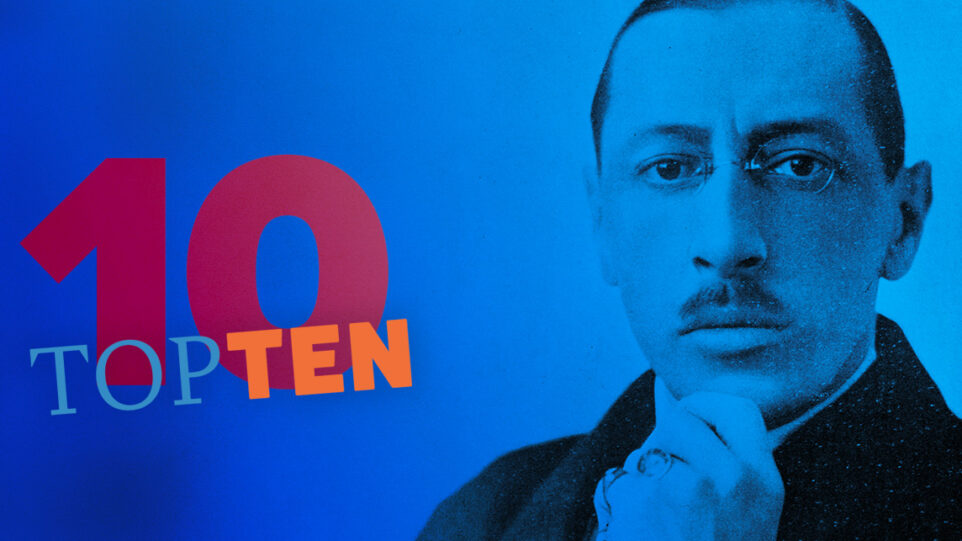
Stravinsky: Rite of Spring (May 29, 1913)
Although it has been pointed out that the famous riot that this piece incited came more from the choreography than from the music, this is still one of the most radical and influential pieces ever composed. We can point to the orchestral colors (when had a bassoon ever been used in this way?) and the “modern” harmonies, and orchestral outbursts, etc., but now we have rhythm as the catalyst of change; driving, harsh beats, often in unexpected places; the syncopation and the savagery. Percussion took center stage with this work.
It is important to say that WFMT is not suggesting these 10 pieces are necessarily the 10 greatest works, but that they revolutionized music. Nothing written after them was quite the same as the music that came before. On Friday, May 10th from 9 AM until 7 PM we will be hearing them all and discussing why they are so important to music history.
Chime in: What Piece of Music Changed the World?
WTTW Channel 11 will air ‘10 Buildings That Changed America’ on Sunday at 9:00 PM. Tomorrow on WFMT we will have our own countdown of the ’10 Pieces That Changed the World.’ Which compositions would be on your list?