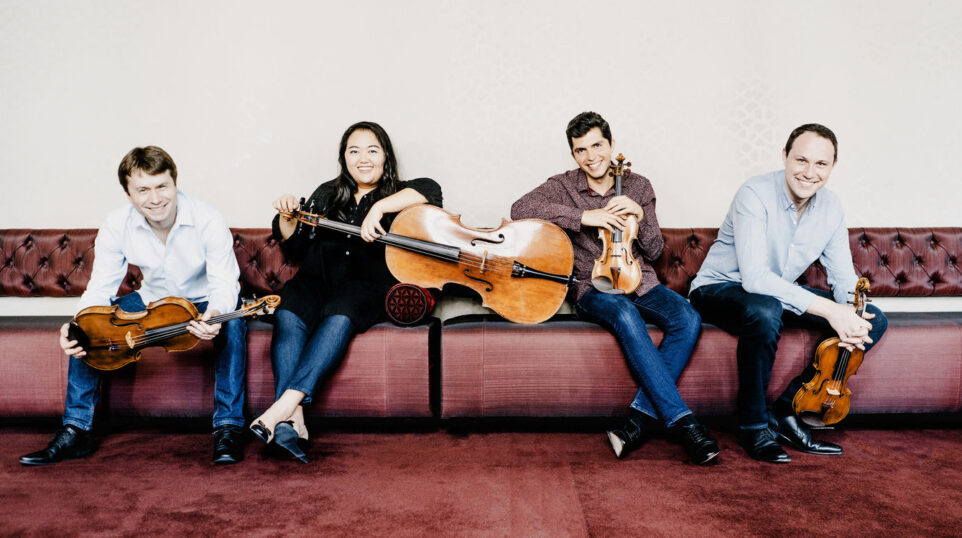
We’re hard at work on another new theme for EM, focusing on the members of the wind quintet (flute, oboe, clarinet, bassoon, and horn).
What is YOUR favorite music for these instruments? Orchestral excerpts, concertos, solo works, chamber music- anything is game. Let us know in the comments section!

Share your Exploring Music theme ideas in the comments below.


Mozart’s Quintet for Clarinet and Strings, K. 581. In the Allegretto con Variazioni about the third variation (about 2:57) into the piece it’s just a violin and strings devoid of clarinet. Why did Mozart do that thematically? It’s been conjectured that this is one of Mozart’s, “cat” distractions, as Mozart was fond of cats, one perhaps got to close to inspire Mozart to eloquently deviate.
竜也
John Lennon once told producer George Martin to make a song sound like
an “orange” with that thought in mind. Exemplifying color in sound is
an interesting concept, for example take Maurice Ravels, “Le Tombeau de Couperin,”
although Ravel composed it for soldiers who had died in World War I, the shimmering notes of the composition exemplifies, ‘to me’, the color “orange.” What would Herr McGluaglin exemplify the color “pink” as? or the color “magenta?” Thank you.
One other note, the first sic, 14 notes of the opening theme to this show “The Expoloring Music Theme (2003)” sounds like an orange:)
JS-Bach keyboard concertos are so atemporal: seems that interpreters have been and are still remarkably fascinated by his creations: Glenn Gould, Andreas Schiff, and now David Fray. How JS Bach came up with such incredibly profound compositions and why does it impact our culture today?
I listen to your program frequently on WQXR-FM (NYC)and I appreciate the illumination you bring to some “dark Musical areas”. I would like to suggest a series of two or three programs on C.V.Alkan. The 2nd volume(The Music)of Ronald Smith’s Biography can be your script! I particularly suggest his three pieces of chamber music as a subject–all masterpieces and almost never played live. I’ve been trying to hear a concert for 20 years with any one (Trio, Grand Duo, or Sonate de Concert. I listen to the recording on Tympani IC1013 by three accomplished but not super-virtuosos! This is some of the best Chamber music of the 19th century–not dated and Modern, anticipating ideas yet to come.
Label: Timpani Catalog #: 1139 It is available from Archive WQXR Partner. The artists are Dong-Suk Kang (violin),Yvan Chiffoleau (cello), and Oliver Gardon (piano).
Mr. M:
I think my previous submission for “suggest music for an upcoming theme” got lost, so….
I am sure you know these, but What The Heck:
Morton Gould, “Interplay” that I know Jerome Robbins did a splendid ballet of in the ’50s, and which may have been used for some radio show in that era that I associate with my adolescent consciousness.
Alan Hovhaness, “Lousadzak”, a sort of piano concerto that I heard on a Louisville Orch “new music” disc in the fifties and remains a fav; Keith Jarrett did a more recent recording.
Oliver Nelson, “Stolen Moments” that’s a wonderful piece of jazz.
Vaughan Williams: okay you probably know everything, but maybe you missed (1) the Partita for Double String Orchestra, and (2) the “Rhosymedre” hymn tune for organ (and there is a version for concert band I haven’t heard).
RE: William Alwyn, two of whose works you featured on the program this week — maybe you don’t know the score he did for the Carol Reed movie “Odd Man Out”, just about the most romantic score for the most romantic movie I’ve ever seen; CHECK OUT THE FILM too if you haven’t seen it.
–
–
…………..
Richard R. Palmer, MD, FAPA Alexandria, Virginia Board-Certified Psychiatry… Psychotherapy, Pharmacotherapy, Combined Therapy, Geropsychiatry, End-of-Life Issues, Out-of-Network® Psychiatric Services (703) 780-0001
……………
“…A man burdened with a secret should especially avoid the intimacy of his physician. If the latter possess native sagacity, and a nameless something more,–let us call it intuition; if he show no intrusive egotism, nor disagreeably prominent characteristics of his own; if he have the power, which must be born with him, to bring his mind into such affinity with his patient’s, that this last shall unawares have spoken what he imagines himself only to have thought; if such revelations be received without tumult, and acknowledged not so often by an uttered sympathy, as by silence, an inarticulate breath, and here and there a word, to indicate that all is understood; if, to these qualifications of a confidant be joined the advantages afforded by his recognized character as a physician;–then, at some inevitable moment, will the soul of the sufferer be dissolved, and flow forth in a dark, but transparent stream, bringing all its mysteries into the daylight…” –Nathaniel Hawthorne, The Scarlet Letter (1850)
“Never eat at a place called Mom’s, never play cards with a guy named Doc, and never go to bed with anyone who has more troubles than you.” –Nelson Algren
“Every normal man must be tempted, at times, to spit on his hands, hoist the black flag, and begin slitting throats.” –H. L. Mencken
“….But the effect of her being on those around her was incalculably diffuse: for the growing good of the world is partly dependent on unhistoric acts; and that things are not so ill with you and me as they might have been, is half owing to the number who lived faithfully a hidden life, and rest in unvisited tombs.”
–from Middlemarch by George Eliot
I think an interesting theme would be a show on Hindemith. He had a very precise method to his writing, which I find fascinating. Also, his wide array of Wind sonatas left most major instruments with a sonata that have become standards in the repertoire.